

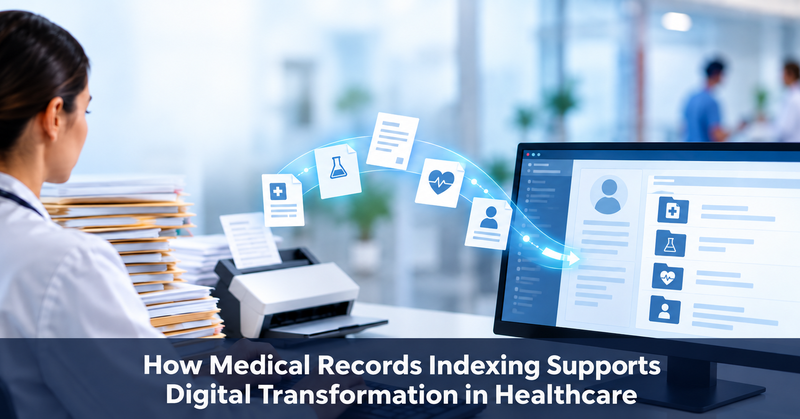
Healthcare organizations continue to generate and receive large volumes of patient information every day. Referrals, lab results, physician orders, clinical notes, insurance documents, and other records must be reviewed, categorized, and added to the correct patient chart quickly and accurately.
Even organizations with established electronic medical record systems can experience indexing backlogs when document volume increases or internal staff are stretched thin.
Medical records indexing services help solve this operational challenge by organizing incoming records, placing them in the correct patient chart and document type, and creating a more consistent digital workflow. For healthcare organizations focused on digital transformation, efficient indexing helps ensure that digital information is not only stored electronically but is also properly organized and available within the systems teams already use.
What Is Medical Records Indexing?
Medical records indexing is the process of reviewing patient documents and classifying them according to predefined criteria such as patient information, document type, date, provider, or department.
While digital scanning services convert paper records into digital files, indexing gives those files structure and context.
For example, a scanned referral may need to be matched to the correct patient, categorized as a referral document, and placed in the appropriate section of the patient’s electronic medical record.
Accurate indexing helps healthcare organizations maintain a more organized digital record environment while reducing the risk of documents being misplaced, misclassified, or left sitting in processing queues.
Indexing Directly Into the Existing EMR
A major advantage of Tronitech’s medical records indexing model is that our indexing team works directly within the healthcare organization’s existing EMR.
There is no need to purchase additional indexing software or implement a separate system. Tronitech’s team operates as an extension of the client’s staff, following the organization’s existing document types, naming conventions, indexing procedures, and workflow requirements.
Our indexing professionals have experience working within widely used EMR platforms, including but not limited to:
- Epic
- eClinicalWorks
- NextGen
- athenahealth
- Veradigm/Allscripts
Working directly in the client’s existing environment can simplify the indexing process by reducing unnecessary transfers between systems and keeping records within established workflows.
Supporting Faster Document Turnaround
Timely indexing is important because unprocessed documents can quickly create operational bottlenecks.
Tronitech provides a standard 24-hour turnaround for medical records indexing, helping healthcare organizations keep incoming records moving through their workflow consistently.
Documents can be reviewed, matched to the appropriate patient, classified under the correct document type, and indexed into the EMR based on the client’s established requirements.
This faster turnaround helps prevent indexing queues from becoming long-term backlogs and supports more consistent availability of patient information for authorized healthcare teams.
Reducing Backlogs and Improving Indexing Accuracy
Healthcare organizations may experience indexing backlogs for many reasons, including staffing shortages, increased patient volume, organizational growth, or temporary spikes in incoming documents.
When internal employees must balance indexing with other responsibilities, processing delays and inconsistencies can become more likely.
Outsourcing medical records indexing allows organizations to assign this specialized administrative function to a dedicated team. Standardized procedures and quality-control processes can help improve consistency while reducing the burden on internal staff.
Instead of spending significant time manually sorting, matching, and filing incoming documents, healthcare employees can focus more of their attention on patient care, clinical support, scheduling, and other core responsibilities.
Flexible Indexing Support as Document Volume Changes
Document volumes do not always remain consistent. A healthcare organization may need additional indexing assistance during periods of higher patient activity, acquisitions, staffing gaps, special projects, or temporary backlogs.
Tronitech provides a flexible staffing model designed around these changing needs.
Healthcare organizations can use dedicated indexing staff and adjust the level of support based on the volume of documents designated to Tronitech. Support is available on a month-to-month basis, and clients are billed based on the actual hours worked.
This approach allows organizations to scale indexing support up or down without maintaining unnecessary internal staffing capacity.
For healthcare leaders, that flexibility can make it easier to manage changing workloads while maintaining a consistent indexing process.
Supporting Security and Compliance
Digital transformation in healthcare must balance efficiency with responsible handling of sensitive patient information.
A structured indexing workflow helps organizations maintain greater consistency in how records are processed, categorized, and stored. Working within the client’s existing EMR also allows indexing activities to follow established organizational access controls and document-handling procedures.
By following client-specific procedures, records management software, maintaining appropriate access controls, and working directly within the existing EMR, Tronitech helps healthcare organizations maintain consistent document-handling practices while supporting their security and compliance requirements.
Creating a More Efficient Digital Healthcare Workflow
Digital transformation is not simply about replacing paper records with electronic files. Healthcare organizations also need reliable processes that ensure incoming information reaches the correct location within their digital environment.
Medical records indexing connects several important parts of that process:
Document intake → review → patient matching → document classification → quality control → EMR indexing
When these steps are handled consistently, healthcare organizations can reduce backlogs, improve turnaround times, maintain better record organization, and respond more effectively to changing document volumes.
Outsourcing can further strengthen this workflow by providing experienced indexing resources without requiring organizations to build additional internal teams or introduce new software.
Medical Records Indexing With Tronitech
Tronitech provides medical records indexing services designed to work within each healthcare organization’s existing processes and technology environment.
Our team can work directly in platforms such as Epic, eClinicalWorks, NextGen, athenahealth, and Veradigm/Allscripts while following client-specific indexing requirements.
With a standard 24-hour turnaround, dedicated indexing staff, month-to-month support, and billing based on actual hours worked, healthcare organizations can adjust support as their document volume and staffing requirements change.
Combined with Tronitech’s digital scanning services, records management software, and secure document management solutions, medical records indexing can help healthcare organizations build a more organized, scalable, and efficient digital workflow.
Dealing with indexing backlogs or spending too much internal staff time processing incoming records? Tronitech can help. Contact our team to learn how our medical records indexing services can support your existing team and EMR workflow.
